EUROPE · 2032 · ALGORITHMIC INCIDENT UNIT
The AI Act never entered into force.Now investigate the consequences.
Thirteen case files. Artificial intelligence systems. Real people. Examine the evidence, classify the risk and sign your inspection report.
NO AI ACT is not a campaign against the AI Act: it is an educational simulation of an unregulated society, where the regulation never entered into force.
CASE FILE 01 / STATUS: OPEN


01The right answer is not enough.
You can pick the correct category and still file a contestable report. The quality of a decision depends on the evidence you cite and how you reason from it.
-
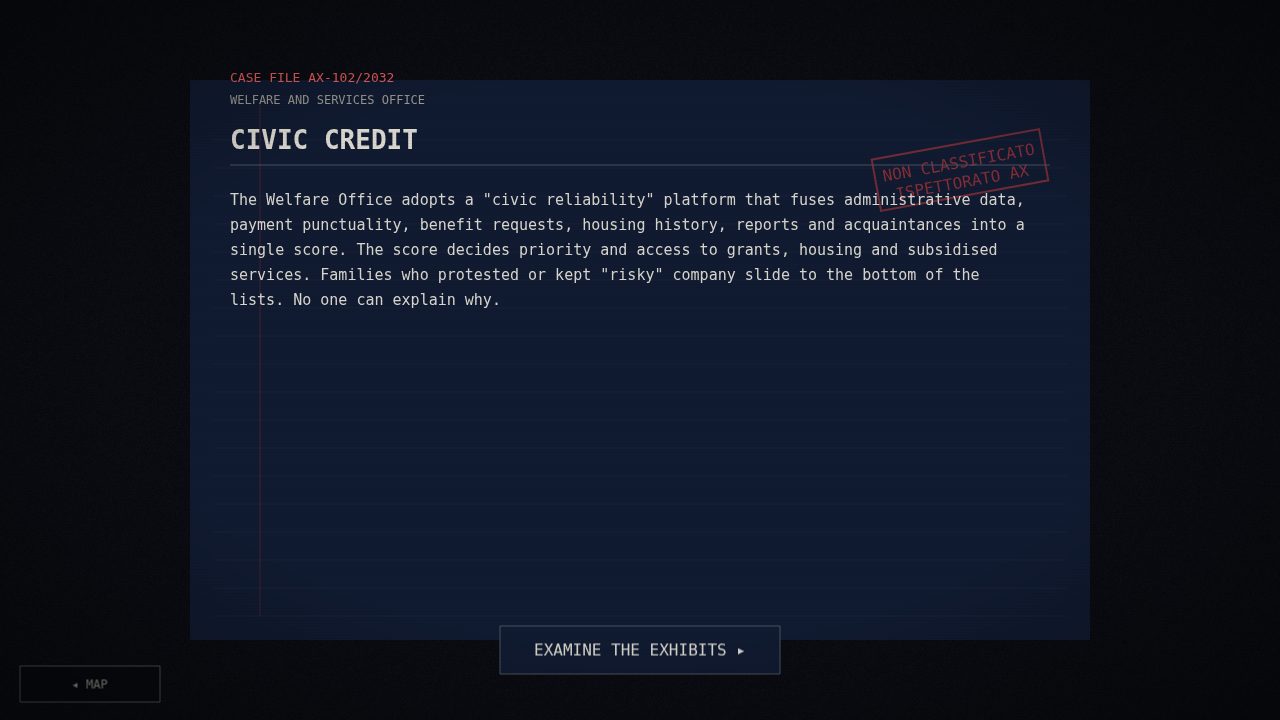
01Open the fileThe context, the AI system involved, the people it affects. -
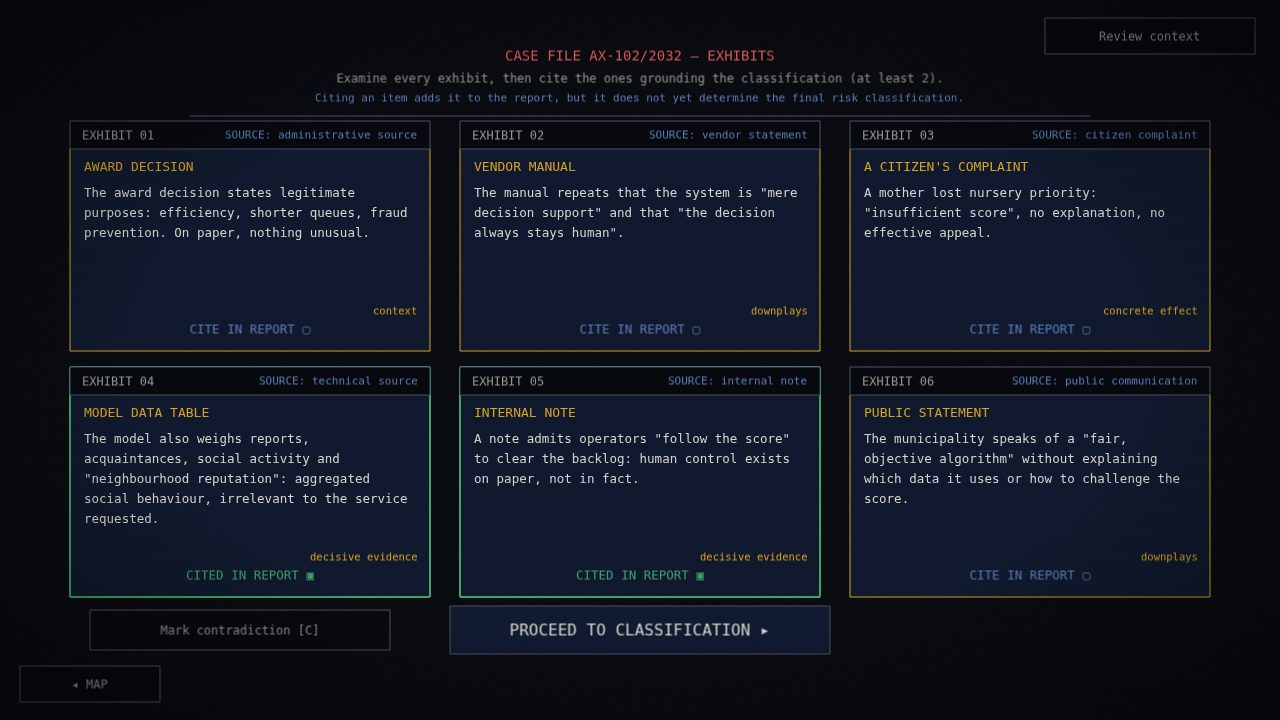
02Examine and cite the exhibitsAdministrative, technical and vendor sources, logs and complaints. At least two exhibits enter the report: the choice matters. -
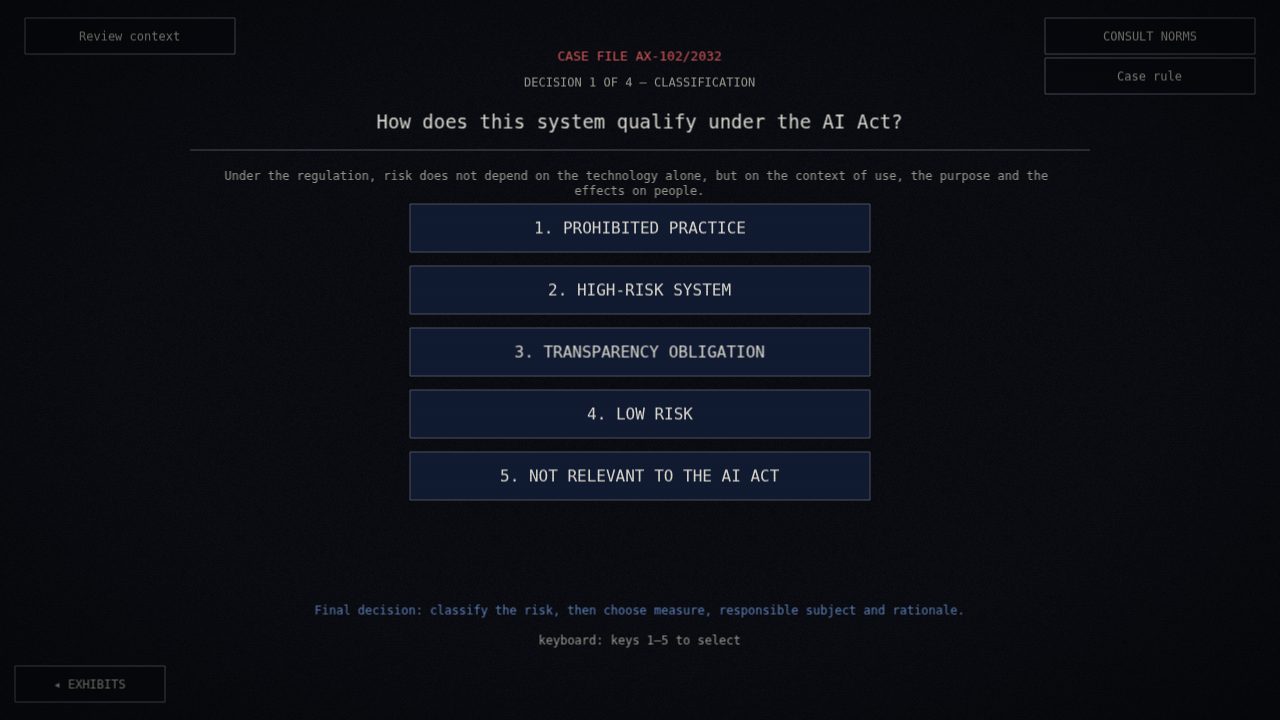
03Classify the riskProhibited, high-risk, transparency duty, minimal risk or out of scope. Then the measure and who is accountable. -
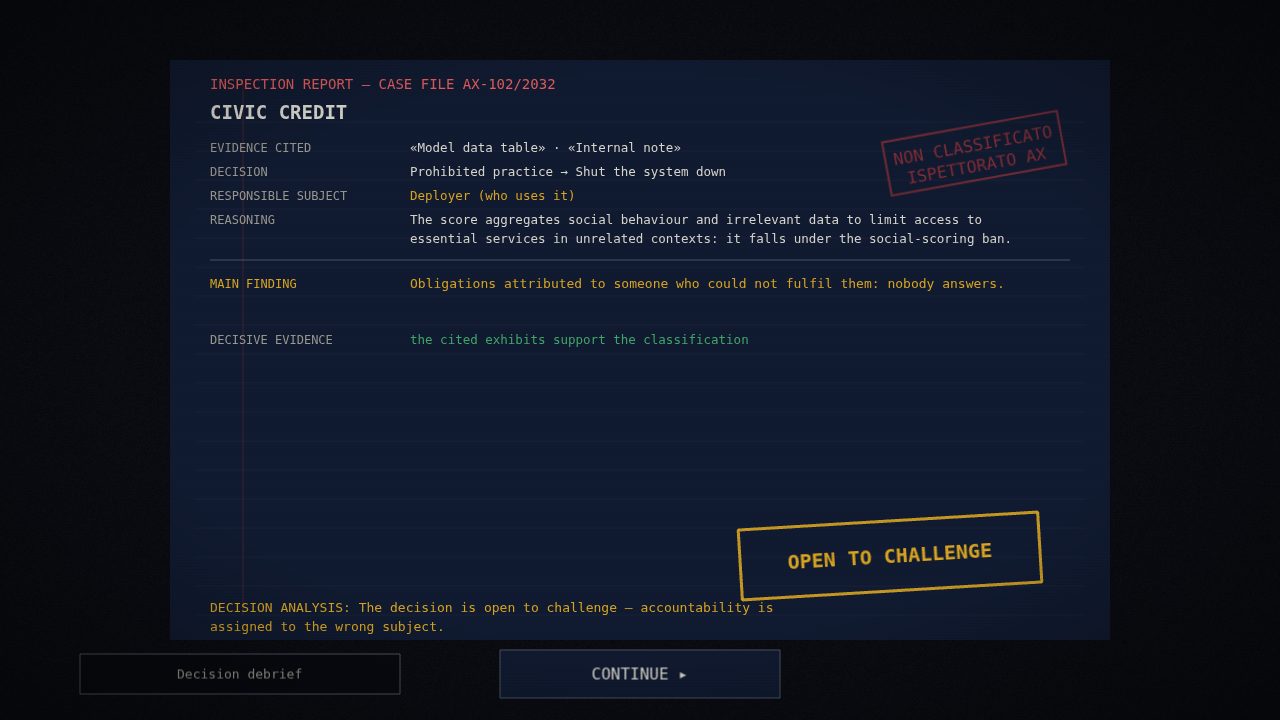
04File the reportReasoning included. The report is judged on the evidence you cited, not on the category alone.


- COMPLIANT
- PARTIALLY COMPLIANT
- CONTESTABLE
- NON-COMPLIANT
Access points
- I want to play nowOpen the first case file. About fifteen minutes.
- I teachFull guide for educators: 30, 60 and 90-minute formats.
- I am preparing a lessonFive ready-to-run activities, with timings and materials.
- I want to understand the AI ActThe plain-language guide, without jargon.
- I am looking for a termShort definitions of the key terms.
- I am evaluating the projectObjectives, method and an honest validation status.
For the classroom: the guide for educators, the education hub, AI literacy and why a serious game. Loop overview: how it works.
02The city reacts.
Every signed decision moves four indicators. After four closed files the city takes a direction: you are not winning a quiz, you are building a governance record.
- Efficiency
- Social control
- Fundamental rights
- Public trust
- Opaque city
- Fragile governance
- Governed innovation
03The open case files.
Thirteen cases, from the clearest to the most ambiguous. Each holds a decisive signal, an account that minimises the problem, and a contextual element that can flip the reading.
- FILE 01AVAILABLE The city of scores Civic administration PROHIBITED PRACTICE One score decides housing, healthcare and school. The penalty migrates across unrelated contexts.
- FILE 02AVAILABLE The interview that never happened Employment and hiring HIGH RISK Automated screening of applications, with no explanation and no way to contest it.
- FILE 03AVAILABLE The synthetic city Public communication TRANSPARENCY A city council floods its channels with generated content, unlabelled and unwatermarked.
- FILE 04AVAILABLE The observed classroom Education · Emotion recognition PROHIBITED PRACTICE The system infers emotional states from students' faces. No way to contest the result.
- FILE 05AVAILABLE Invisible triage Healthcare HIGH RISK Excellent averages, errors concentrated on certain groups, and blind trust from supervisors.
- FILE 06AVAILABLE Faces in the crowd Public space · Biometrics PROHIBITED PRACTICE Live biometric identification, in public squares, for law-enforcement purposes.
- FILE 07AVAILABLE Civic credit Welfare · Credit BOUNDARY CASE Mirror case: where does creditworthiness assessment end and social scoring begin?
- FILE 08AVAILABLE The desk that always answers Citizen services TRANSPARENCY An automated assistant creates reliance. The disclosure exists — but is it enough?
- FILE 09AVAILABLE The opaque tender Public procurement HIGH RISK AI procurement with no technical documentation and no declared governance.
- FILE 10AVAILABLE The profiled classroom Adaptive EdTech HIGH RISK A learning platform profiles students and steers their educational path.
- FILE 11AVAILABLE The do-it-all model GPAI · Downstream use GPAI A general-purpose model used downstream in internal decisions nobody classified.
- FILE 12AVAILABLE The marked district Predictive policing PROHIBITED PRACTICE Predicting the person, not the phenomenon: the line the AI Act draws sharply.
- FILE 13AVAILABLE The algorithm of suspicion Welfare · Fraud detection HIGH RISK Fraud scoring on an essential benefit, with human oversight in name only.
04They opened the file.
“Un caso costa quindici minuti e vi lascia con un'idea più chiara…”
Read the article ▸
05From playtest to research.
The project is built to be studied, not only played. The methodological framework is public; empirical validation of its educational effectiveness has not been carried out, and until it is you will find no numbers on this page.
Nine typed learning objectives and nine expected misconceptions, mapped case by case.
Provision area → rule cards → cases, in machine-readable form.
Pre/post questionnaires and reproducible stimuli described in the validation framework.
No completed study. The missing data is declared, not estimated.
06Take it into the classroom.
- 30 minOne case and a guided discussion.
- 60 minInvestigation, group comparison and debrief.
- 90 minFull session, groups and a closing round.
- No student accounts
- No results sent to any server
- Teacher mode with a local debrief
- Exports stay on the device
- Classroom activities ready to run
07The code is open. Your cases stay yours.
OPEN SOURCE
- Public source code on GitHub
- GPL-3.0 licence for the code
- CC BY-SA 4.0 for the educational content
- Every change goes through a pull request
LOCAL FIRST
- No account, no registration
- The game runs entirely in the browser
- Progress stays in localStorage
- No inspection report is sent to a server
- Public pages use Cloudflare Web Analytics: aggregate statistics, no cookies
The game collects no personal data and does not send results, answers or inspection reports to any server. Public pages use aggregate, privacy-friendly statistics via Cloudflare Web Analytics.
08Want to understand the rule before investigating?
09Frequently asked questions
What is NO AI ACT?
Is NO AI ACT legal advice?
Do I need to register or create an account?
How many cases can I play?
Is it suitable for classroom teaching?
Does NO AI ACT collect personal data?
Every other question lives on its own page: Privacy and data · Classroom use · How to cite the project · Research and methodology
CASE FILE / STATUS: AWAITING INSPECTOR
The next file is open.
No registration. No download. About fifteen minutes.
Simplified educational simulation — not legal advice.